

Choosing the right gas boiler kW capacity is one of the most important decisions for boiler distributors, importers, installers, and heating-system designers.
A boiler that is too small may struggle to meet peak heating demand. A boiler that is significantly oversized may spend much of its operating time at low load, increasing cycling and making it harder to operate efficiently.
For international boiler buyers, the challenge is even greater. A 24 kW boiler may be suitable for one market but insufficient for another, while the same 30 kW combi boiler may be selected primarily for domestic hot water rather than space heating.
So how should you choose the right gas boiler kW capacity for your project? The answer is not simply to choose the largest available model. The correct approach is to evaluate building heat load, climate, insulation, heating system design, domestic hot water demand, boiler minimum output, and modulation capability together.
What Does Gas Boiler kW Capacity Mean?
The kW rating of a gas boiler describes its heating power. In simple terms, 1 kW equals 1,000 watts of power, and a boiler’s heating output indicates how quickly it can deliver useful heat to the heating system.
For example:
- 20 kW boiler → approximately 20 kW maximum heating output
- 24 kW boiler → approximately 24 kW maximum heating output
- 28 kW boiler → approximately 28 kW maximum heating output
- 32 kW boiler → approximately 32 kW maximum heating output
- 35 kW boiler → approximately 35 kW maximum heating output
Buyers should distinguish between heat input and heat output. Heat input is the energy supplied to the boiler through gas combustion; heat output is the useful heat delivered to the heating system. For boiler selection, the useful heating output is generally the figure that matters most when matching the appliance to the building’s heat demand. The exact terminology and rating method can vary by product standard and test condition, so always compare specifications on the same basis — the Energy Saving Trust’s energy jargon buster is a useful reference for these terms.
Boiler Size Should Start With Heat Load
The first question should not be “How many kW is the boiler?” It should be “How many kW of heat does the building actually require?”
The heating load is the amount of heat that must be supplied to maintain the desired indoor temperature under the design outdoor conditions. A proper heat-load calculation considers factors such as:
- Building floor area
- Outdoor and indoor design temperature
- Wall, roof, and floor insulation
- Window area and U-values
- Air infiltration and ventilation
- Building orientation and occupant count
- Heating system design and local climate
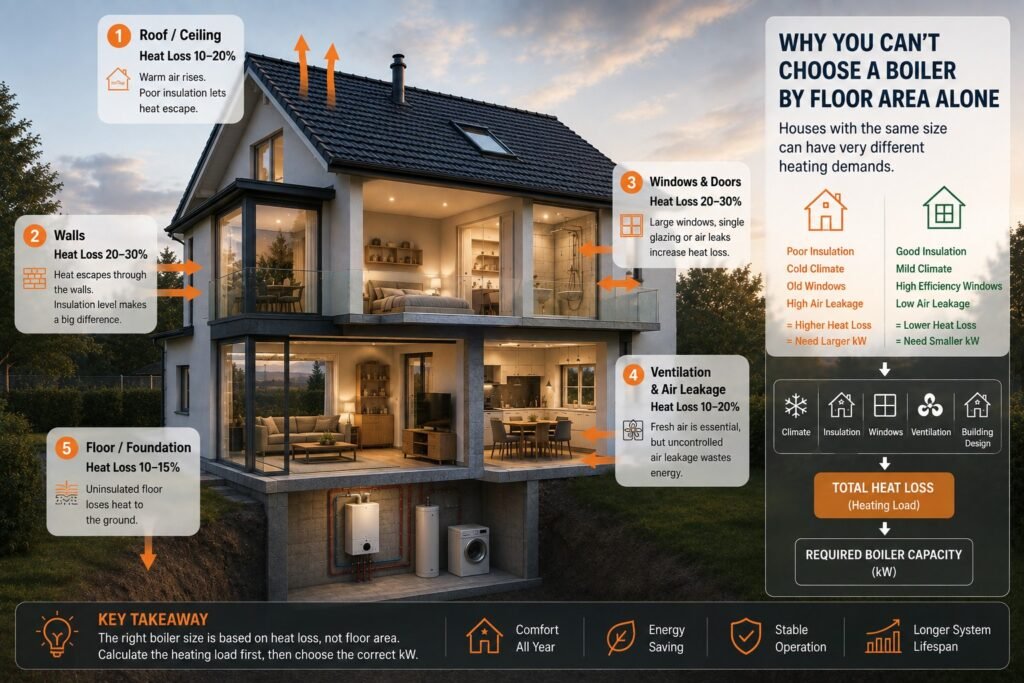
A simplified concept is: Required Heating Capacity ≈ Building Heat Loss at Design Conditions. This is why floor area alone should not be the final method for boiler sizing — a 150 m² well-insulated building in a mild climate can have a very different heating requirement from a 150 m² poorly insulated building in a cold continental climate.
Why Floor Area Alone Is Not Enough
A common shortcut in the market is a rule such as “X kW per 100 m².” This can be useful for an initial product discussion, but it should not replace an actual heat-load calculation. For professional projects, the building envelope and local design conditions should be evaluated first — sizing heating systems around actual heat demand, rather than simply selecting a large boiler, is the more reliable approach. Recognized methods such as the Energy Saving Trust’s CE54 domestic heating sizing method illustrate how a structured, whole-house calculation goes well beyond a simple per-m² rule.
What Gas Boiler kW Capacity Is Suitable for Different Applications?
There is no universal kW-to-floor-area chart that works for every country. For initial product selection, distributors often work with common residential boiler ranges such as:
| Boiler Capacity | Typical Market Position | Typical Application |
|---|---|---|
| 18–20 kW | Small capacity | Smaller residential heating systems |
| 24 kW | Mainstream residential | Small to medium homes |
| 28 kW | Medium capacity | Medium homes / higher DHW demand |
| 30–32 kW | Medium-high capacity | Larger homes / higher DHW demand |
| 35–36 kW | High residential capacity | Larger homes / higher DHW demand |
| 40 kW+ | Higher capacity | Larger residential or light commercial applications |
These ranges are market categories, not fixed sizing rules. Actual selection should be based on the building heat load and, for combi boilers, the required domestic hot water performance. ROC’s traditional wall-hung boiler range, for example, includes models from approximately 20 kW to 40 kW heat input across different heating output levels — a reminder that the advertised kW number should always be checked against actual heating output.
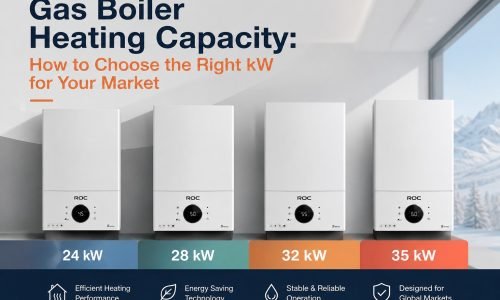
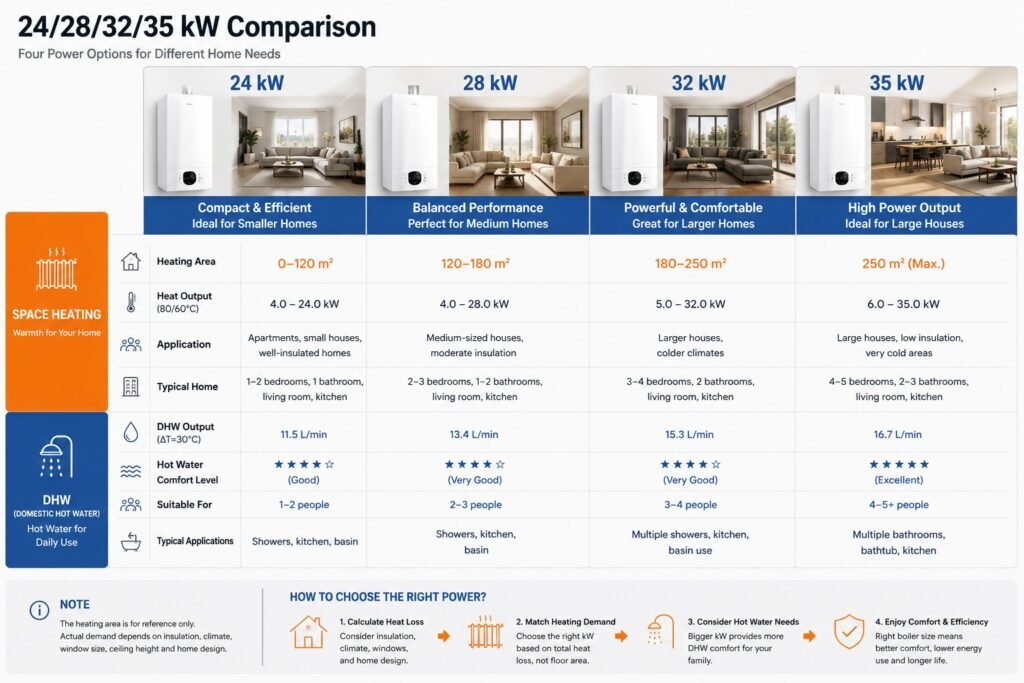
24 kW vs 28 kW vs 32 kW vs 35 kW Boilers
These four capacity classes are particularly common when discussing gas boiler kW capacity for residential wall-hung boilers. But the difference is not simply “35 kW heats a bigger house than 24 kW.” For combi boilers, the higher capacity may also be needed to provide sufficient domestic hot water flow rate, which creates two separate sizing questions:
- Space heating — how much heat does the building require?
- Domestic hot water — how much hot water needs to be delivered, and at what temperature rise and flow rate?
A combi boiler can therefore have a relatively high maximum output even when the building’s space-heating load is much lower — one reason boiler maximum output can appear significantly higher than the actual heating requirement.
Why Combi Boilers Are Often Larger Than the Heating Load
This is one of the most important concepts for boiler distributors. Imagine a house with a calculated space-heating demand of approximately 8–12 kW. A 24 kW combi boiler may still be selected because the appliance must provide instantaneous domestic hot water.
In other words: Space Heating Demand ≠ Required Combi Boiler Maximum Output. The boiler may need a higher maximum output for acceptable hot water performance while still being capable of reducing output when space-heating demand is low — which is exactly where modulation ratio becomes important. See our related guide, Boiler Modulation Ratio Explained: Why 1:5, 1:7 and 1:10 Matter.
Maximum Output Is Only Half of the Story
When comparing boilers, many buyers look at the maximum kW rating first — and it’s tempting to assume the highest-rated model is automatically the better product. That isn’t necessarily true. A better comparison includes:
- Maximum and minimum heating output
- Maximum and minimum heat input
- Modulation ratio and minimum stable operating level
- Domestic hot water output
- Efficiency at part load
- Control strategy
Consider a simplified example:
| Boiler | Maximum Output | Minimum Output | Approx. Modulation |
|---|---|---|---|
| A | 24 kW | 8 kW | 3:1 |
| B | 24 kW | 4.8 kW | 5:1 |
| C | 24 kW | 3.4 kW | 7:1 |
All three boilers share the same nominal maximum capacity, but their low-load operating capabilities differ significantly. If the building only requires 4 kW of heating, Boiler A cannot continuously match that demand because its minimum output is around 8 kW. Boiler B is much closer, and Boiler C has even more low-load flexibility. This is why minimum output can be just as important as maximum output.
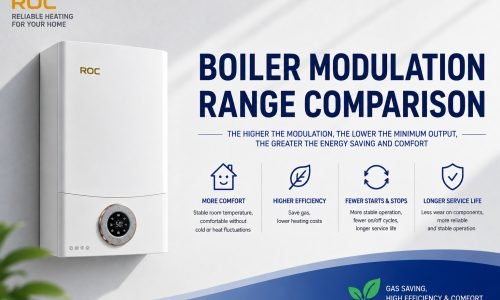
The Relationship Between Boiler Capacity and Modulation
A boiler’s modulation ratio describes how far the burner can reduce its firing rate from maximum to minimum stable operation:
Modulation Ratio = Maximum Heat Input ÷ Minimum Heat Input
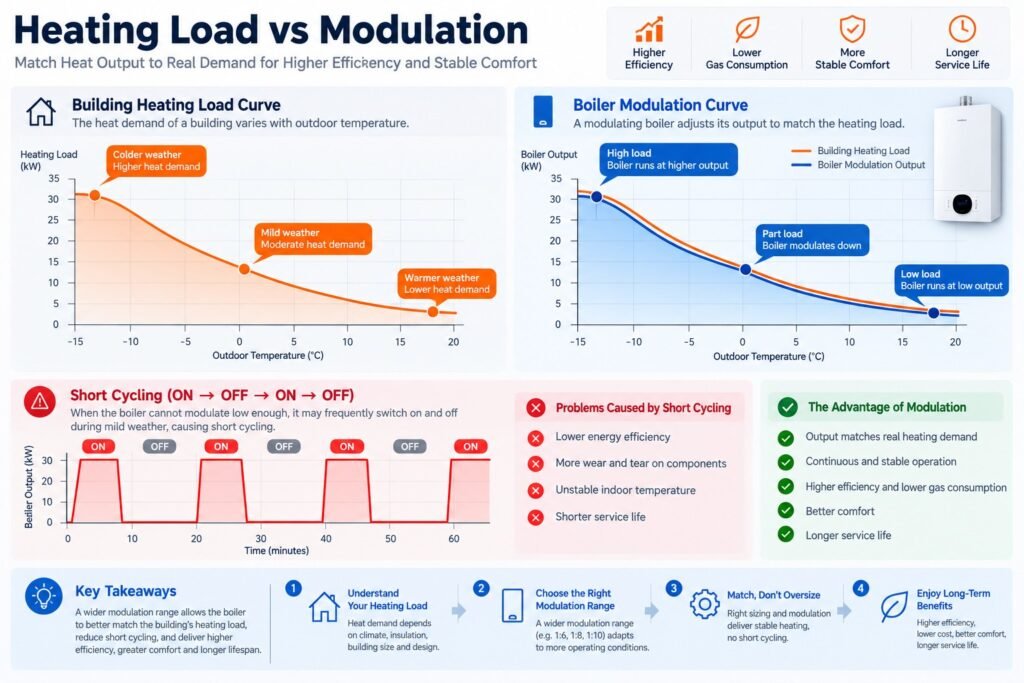
For example, 24 kW ÷ 4.8 kW = 5, giving an approximate 1:5 modulation ratio. A wider modulation range allows the boiler to operate at lower output as heating demand falls — which matters because demand changes continuously throughout the day (for example, 12 kW → 8 kW → 5 kW → 3 kW → 7 kW). Ideally, the boiler reduces its output to track actual demand rather than running at maximum continuously.
What Happens When a Boiler Is Oversized?
Oversizing means the boiler’s available output is substantially greater than the heating system’s actual requirements. Some oversizing is unavoidable, particularly for combi boilers where DHW demand influences maximum capacity — but the problem becomes significant when the boiler cannot reduce its output enough during low-load conditions.
For example: building demand of 3 kW, boiler maximum output of 30 kW, and boiler minimum output of 10 kW. Even though the maximum-to-demand ratio looks like 10:1, the minimum available output is still more than three times the building’s current requirement. The boiler reaches its target temperature quickly, shuts down, then restarts when more heat is needed — a pattern known as short cycling. The U.S. Department of Energy’s federal boiler purchasing guidance notes that a boiler system should be able to meet peak demand while also operating efficiently at part load — which is exactly the balance that correct gas boiler kW capacity selection is trying to achieve.
Climate Matters When Selecting Boiler Capacity
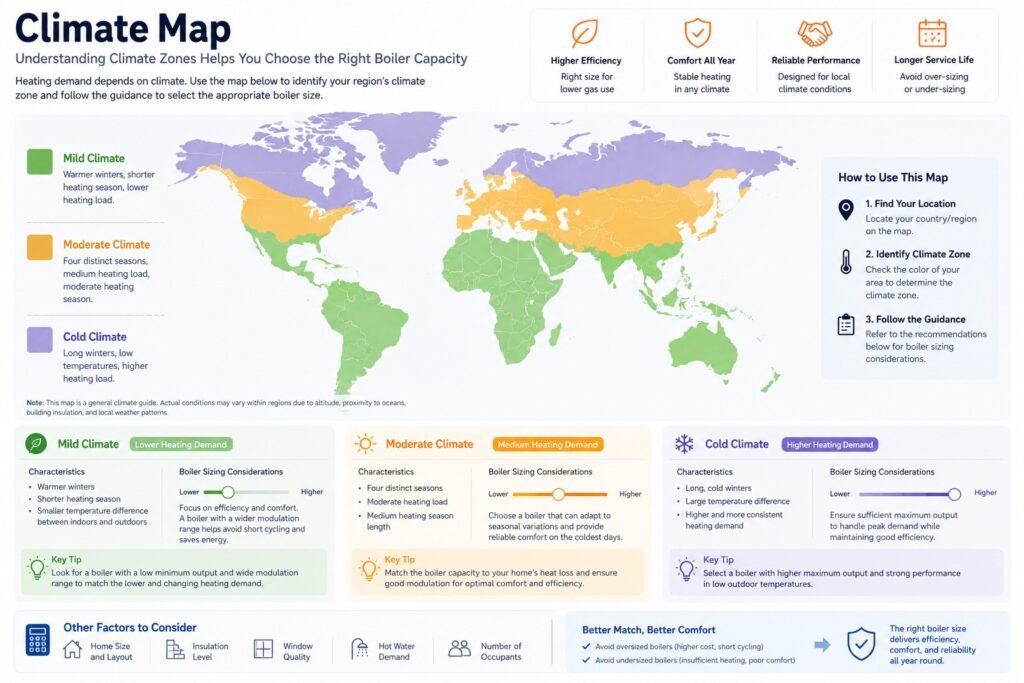
The same boiler model should not automatically be recommended for every country — climate has a direct influence on peak heating demand. For international distributors, selection should consider:
- Mild climate: lower peak heating demand, longer periods of part-load operation, low minimum output and modulation capability become especially valuable
- Moderate climate: wider seasonal variation, moderate peak demand, balanced importance of maximum and minimum output
- Cold climate: higher design heating load, greater importance of maximum heating capacity, while low-temperature operation and modulation remain important outside peak winter conditions
Building Insulation Changes the Required Boiler Capacity
Two buildings with the same floor area can have very different heat-loss characteristics. A building with good wall insulation, modern double/triple glazing, a well-insulated roof and low air leakage can require substantially less heating capacity than a similarly sized building with poor insulation, older windows and higher infiltration — even at the same floor area.
This is why distributors should avoid a simplistic statement such as “24 kW is suitable for 200 m².” A more professional specification is: final boiler capacity should be selected according to calculated heat load, local climate, building insulation, heating system design, and DHW requirements — an approach that is also much easier to adapt across different export markets.
Heating-Only, System and Combi Boilers Need Different Selection Logic
Boiler configuration also affects how capacity should be selected:
- Combi boiler — provides space heating plus instantaneous domestic hot water; maximum capacity is often driven heavily by DHW demand.
- System boiler — normally works with a separate hot water cylinder, so output can be selected more directly around the heating load while the cylinder handles stored DHW capacity.
- Heat-only boiler — typically integrated into a more traditional heating system, often paired with separate hot water storage.
For a broader comparison of configurations and applications, see How to Choose the Right Wall-Hung Boiler for Europe, the Middle East and South America.
How Should Distributors Select Boiler Capacity for a New Market?
For distributors and importers, boiler selection should start with the market rather than a single product:
- Identify the target building types — apartments, detached houses, villas, townhouses, small commercial buildings, renovation vs. new construction.
- Understand the local climate — winter design temperature, heating season length, typical and peak outdoor temperatures.
- Identify typical building standards — insulation levels, window specifications, building age, typical floor area, emitter type.
- Determine DHW requirements — number of bathrooms, simultaneous water use, required flow rate, incoming and target water temperatures.
- Select the capacity range — build a portfolio (e.g. 20 → 24 → 28 → 32 → 35 kW) and adjust it to actual market demand.
- Check minimum output — an often-overlooked step: compare it against typical low-load heating demand.
- Check local certification requirements — verify the configuration meets applicable gas-appliance, efficiency, emissions, and installation requirements in the target market.
For international sourcing, certification should be considered together with technical specifications rather than as a separate issue. See How to Import Wall-Hung Boilers from China: Complete Guide for Distributors for a broader overview of supplier evaluation, certification, OEM requirements, and product selection.
A Practical Gas Boiler kW Capacity Selection Example
Consider a hypothetical residential project: 180 m² floor area, moderate climate, good insulation, a calculated peak heating load of 11 kW, combi boiler required, moderate DHW demand.
The first instinct might be to choose a boiler close to 11 kW — but an 11 kW combi boiler may not provide the required instantaneous domestic hot water performance. A 24 kW or 28 kW combi boiler could be considered instead, depending on required DHW flow rate. Suppose the 24 kW model has a minimum heating output of 4.8 kW, and the 28 kW model has a minimum heating output of 5.5 kW — in this case, the 24 kW model may offer a better low-load operating range even though its maximum output is lower.
The final choice should weigh heating load + DHW demand + minimum output + modulation + local requirements together, rather than simply choosing the highest kW rating.
What Technical Data Should Buyers Request From a Boiler Manufacturer?
When comparing suppliers, ask for complete technical data rather than only the headline capacity:
| Parameter | Why It Matters |
|---|---|
| Maximum heating heat input | Defines maximum fuel input |
| Minimum heating heat input | Shows low-load capability |
| Maximum heating output | Helps match heating demand |
| Minimum heating output | Critical for low-load operation |
| Modulation ratio | Indicates operating range |
| DHW output / flow rate | Important for combi boilers and user comfort |
| Efficiency / part-load efficiency | Indicates thermal and seasonal performance |
| Gas type and pressure | Determines market and installation compatibility |
| Heat exchanger material | Relevant to durability and application |
| Control system | Influences modulation and system integration |
| Certification | Required for market access |
ROC’s product specifications publish both maximum and minimum heating heat-load and heat-output figures across different boiler models, allowing buyers to evaluate the full operating range rather than relying on the nominal kW number alone.
How ROC Approaches Boiler Capacity Selection
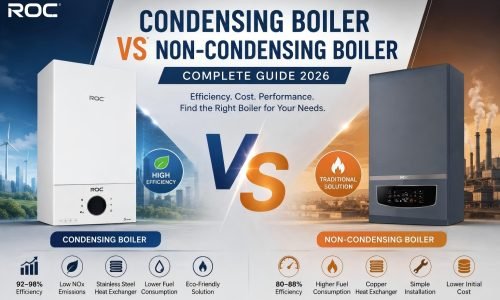
ROC develops wall-hung gas boilers for different residential and commercial heating applications, including both conventional and condensing technologies. The product range covers different capacity classes so distributors can build a portfolio around their target market rather than relying on a single boiler size.
ROC’s condensing range, for example, provides models with different maximum and minimum heating capacities, allowing distributors to compare both capacity and low-load operation. For markets where efficiency and low-load performance are priorities, ROC’s condensing boiler solutions combine full premix combustion technology with modulation and condensing operation. Explore the wider range of ROC wall-hung gas boilers, and for private-label or customized products, ROC also provides OEM solutions for international markets.
The Right Boiler Is Not Necessarily the Biggest Boiler
A professional selection should balance peak heating load, domestic hot water demand, minimum heating output, modulation range, climate, building characteristics, and local regulations. The most important principle is simple:
Choose a boiler that can meet the maximum demand while also operating efficiently at the much lower loads that occur during most of the heating season.
For distributors, this matters even more because the “right” boiler capacity can vary considerably between markets. A successful boiler portfolio is not simply a collection of high-output models — it’s a range of products that can cover different building loads, climate conditions, DHW requirements, and market regulations.
Frequently Asked Questions
Is a higher kW gas boiler better?
Not necessarily. A larger gas boiler kW capacity can provide more heating or DHW capacity, but an oversized boiler may operate inefficiently at low loads if its minimum output is too high.
How do I calculate the required boiler kW?
Start with a proper building heat-load calculation based on heat loss, climate, insulation, ventilation, and design temperatures. For combi boilers, also evaluate domestic hot water demand.
Is 24 kW enough for a house?
It depends on the building and application. A 24 kW boiler may provide sufficient space heating for many residential applications, and its DHW performance may also suit some combi applications.
What is the difference between 24 kW and 28 kW boilers?
The 28 kW model generally provides a higher maximum output, but the practical difference depends on both heating output and DHW performance — minimum output and modulation range should also be compared.
Does a larger boiler heat a house faster?
Not necessarily. Once a boiler can meet the building’s peak heating demand, additional maximum capacity may not provide meaningful benefits for space heating, though it can improve instantaneous DHW performance for combi boilers.
Why is minimum boiler output important?
Minimum output determines how far the boiler can reduce its heating power before it must cycle off. A lower minimum output helps the boiler better match low heating demand.
Should boiler size be based on floor area?
Floor area is useful for preliminary estimation, but it shouldn’t be the sole basis for professional boiler sizing. Building heat loss, climate, insulation, ventilation, and system requirements should also be considered.
What kW boiler is suitable for a cold climate?
Cold-climate projects generally require higher peak heating capacity, but the exact requirement depends on local design temperatures and building heat loss. A professional heat-load calculation should be used before final selection.
Why can a combi boiler be much larger than the heating requirement?
Because maximum output may be determined partly by instantaneous domestic hot water demand. The boiler can then modulate down during space-heating operation, when the building requires much less heat.
Final Takeaway
The right gas boiler kW capacity is not the biggest number on the specification sheet. For professional boiler selection, buyers should look at the complete operating range: maximum output → minimum output → modulation → heating load → DHW demand → climate → system design.
A correctly selected boiler should have enough maximum capacity to meet peak requirements while being capable of operating at low output during normal part-load conditions. For international distributors and OEM buyers, this approach provides a more reliable way to build a boiler portfolio that fits the actual requirements of each market.
Looking for the right gas boiler kW capacity for your market? Contact ROC to discuss your heating requirements, target market, and product configuration.