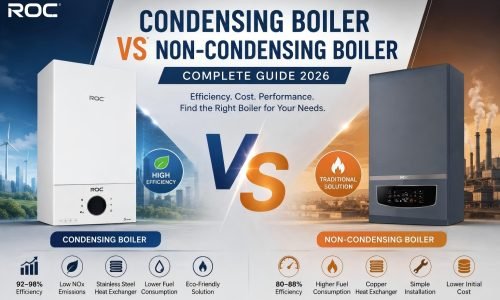


Condensing boiler vs non-condensing boiler is one of the first decisions homeowners, installers, distributors, and project contractors face when specifying a heating system. Both deliver reliable space heating and domestic hot water, but they differ sharply in efficiency, running cost, installation requirements, and emissions.
This guide breaks down the technical and commercial differences so you can match the right boiler technology to the right project.
What Is a Condensing Boiler?
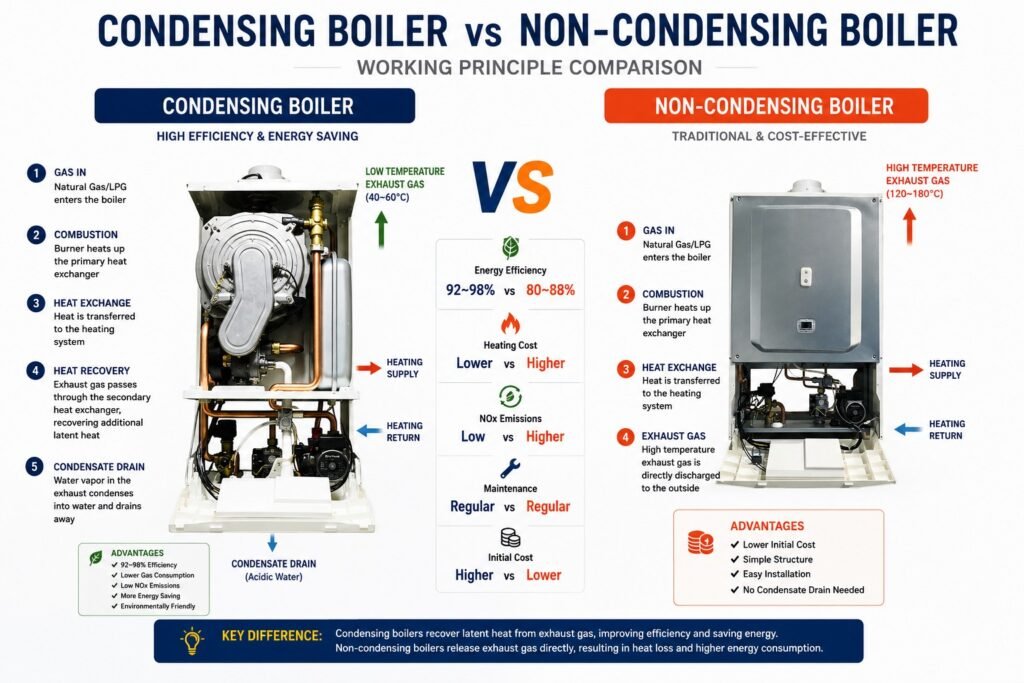
A condensing boiler is a high-efficiency gas boiler that recovers heat from exhaust gases before they leave the flue. Instead of venting this heat outdoors, the boiler condenses water vapor in the flue gas and uses the recovered latent heat to preheat the return water — cutting fuel consumption in the process.
Modern condensing boilers typically reach 92–98% efficiency, making them the standard specification across Europe, Russia/CIS, and most markets with active energy-efficiency regulation.
Key Features
- High thermal efficiency (92–98%)
- Lower gas consumption per kWh delivered
- Low NOx emissions
- 316L stainless steel heat exchanger
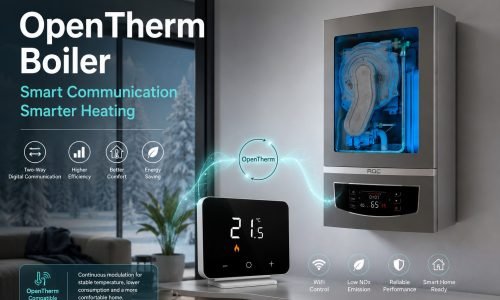
- OpenTherm and smart control compatibility
- Works with natural gas and LPG
What Is a Non-Condensing Boiler?
A non-condensing (conventional) boiler transfers heat directly from combustion to the heating water without recovering waste heat. Flue gases leave the chimney at a much higher temperature, so a portion of the energy is lost to the atmosphere.
Despite lower efficiency, non-condensing boilers remain common in markets where upfront cost outweighs long-term energy savings, or where condensing regulations aren’t yet mandatory.
Typical Features
- Simpler internal structure
- Lower purchase cost
- Faster, easier installation
- Copper heat exchanger
- Lower parts complexity, fewer failure points
- Widely used across developing and price-sensitive markets
Condensing Boiler vs Non-Condensing Boiler: Side-by-Side Comparison
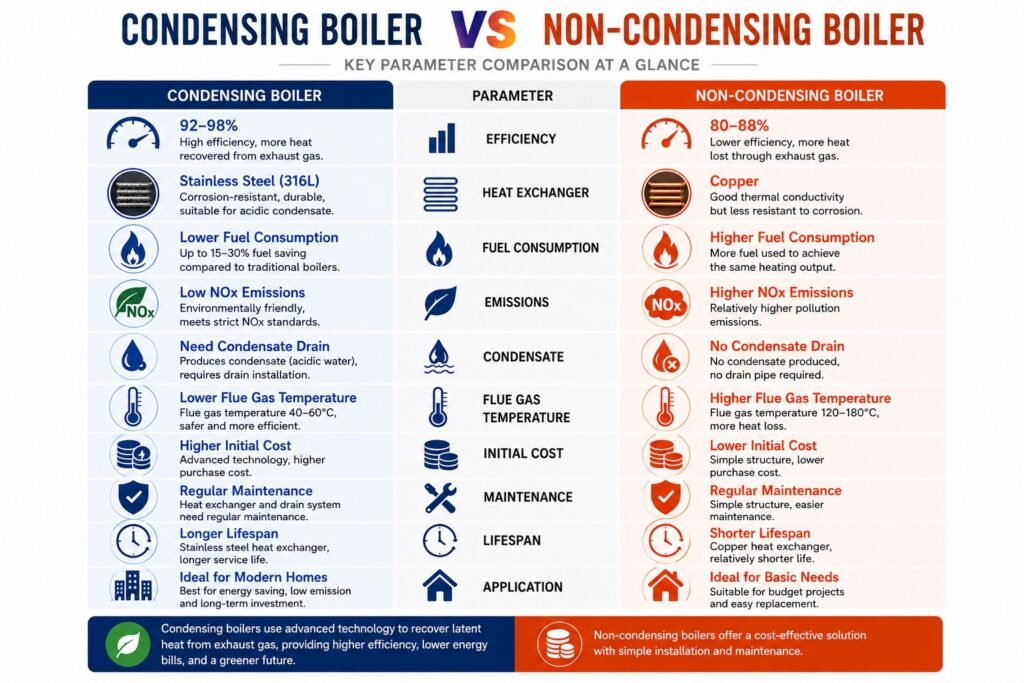
| Feature | Condensing Boiler | Non-Condensing Boiler |
|---|---|---|
| Efficiency | 92–98% | 80–88% |
| Fuel Consumption | Lower | Higher |
| Initial Cost | Higher | Lower |
| Running Cost | Lower | Higher |
| Heat Exchanger | Stainless Steel (316L) | Copper |
| Exhaust Temperature | Low | High |
| Condensate Drain | Required | Not required |
| Environmental Impact | Low NOx | Higher emissions |
| Best Application | Long-term residential & commercial projects | Budget-sensitive projects |
Energy Efficiency Comparison
The biggest advantage of a condensing boiler is fuel efficiency. Rather than letting hot exhaust gases escape through the flue, it captures latent heat from water vapor and reuses it to preheat return water.
In practice, this typically cuts annual gas consumption by 10–20%, depending on the heating system design, climate, and how low the return water temperature runs. Commercial buildings with high annual heating demand tend to see the largest lifetime savings, since the efficiency gap compounds over thousands of operating hours per year.
Installation Differences
Installation requirements are one of the clearest practical differences between a condensing boiler and non-condensing boiler, and often decide which option fits a given property.
Condensing Boiler Requirements
- Condensate drain pipe (acidic condensate needs proper disposal)
- Correctly sized and routed flue for condensing-grade materials
- Low return water temperatures for peak efficiency
- Professional commissioning and combustion analysis
Non-Condensing Boiler Requirements
- Standard flue system
- No condensate drainage
- Simpler like-for-like replacement in older heating systems
For retrofit projects, installers should check whether the property can accommodate condensate drainage and flue upgrades before specifying a condensing model — this is often the deciding factor, not price alone.
Maintenance Comparison
Whether you choose a condensing boiler or non-condensing boiler, both types need annual servicing — but the maintenance focus differs.
Condensing Boiler
- Clean the condensate trap
- Inspect the stainless steel heat exchanger
- Check the condensate drain for blockages
- Analyze combustion efficiency
Non-Condensing Boiler
- Clean the burner
- Inspect the copper heat exchanger
- Check the gas valve
- Verify circulation pump operation
Routine servicing protects efficiency and extends service life regardless of which technology is installed.
Which Boiler Saves More Money?
Condensing boilers cost more upfront, but the fuel savings from higher efficiency often recover that difference within a few heating seasons — especially for households or buildings running heat throughout winter.
For distributors and project developers, condensing technology also helps meet increasingly strict efficiency regulations across European and other regulated markets, reducing the risk of a product becoming non-compliant mid-project. According to the International Energy Agency, high-efficiency heating equipment is a key lever for reducing building-sector emissions worldwide.
Which Boiler Is Better for Your Application?
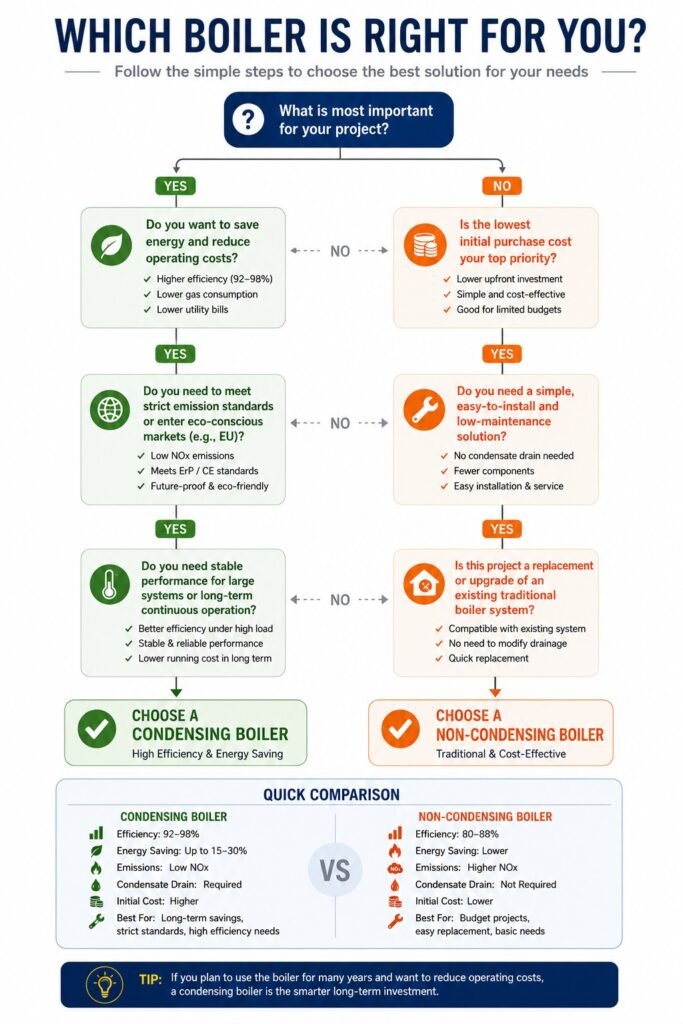
The condensing boiler vs non-condensing boiler decision usually comes down to how the property will be used, not just budget.
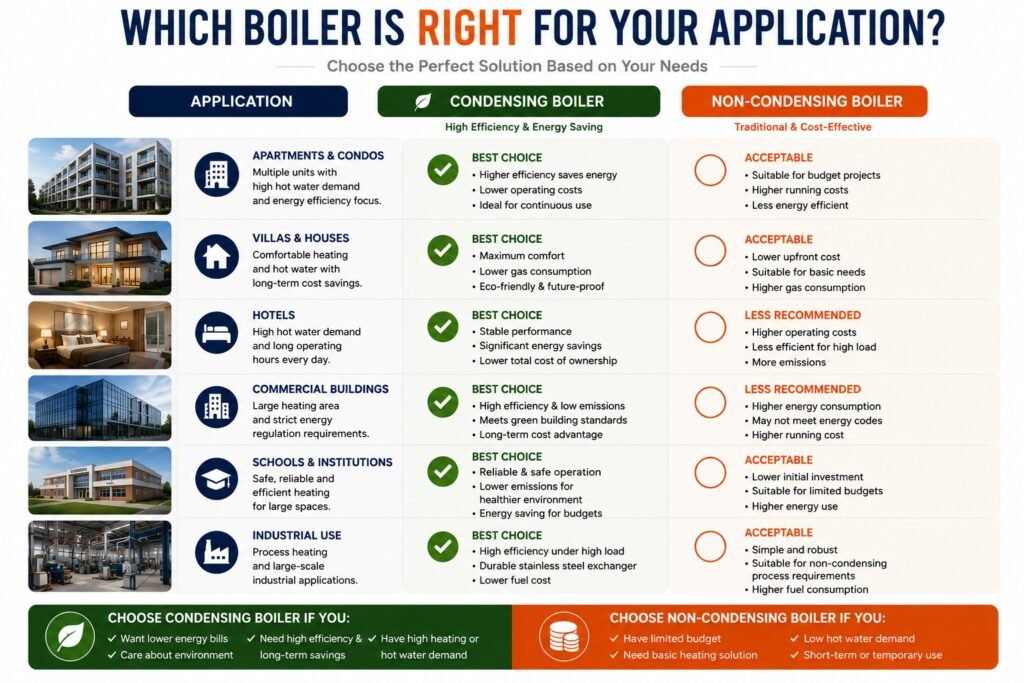
Choose a Condensing Boiler If You:
- Want maximum energy efficiency
- Need the lowest possible operating cost
- Are building a new home or commercial space
- Need CE-compliant products for European markets
- Want lower carbon emissions
- Plan to keep the system running long-term
Choose a Non-Condensing Boiler If You:
- Have a limited upfront budget
- Need a straightforward replacement system
- Operate in markets without condensing mandates
- Prioritize the lowest possible purchase price
ROC Boiler Solutions
ROC manufactures both condensing and non-condensing wall-hung gas boilers for residential and commercial applications, backed by over 30 years of manufacturing experience — giving distributors a single source for both sides of the condensing boiler vs non-condensing boiler decision.
Condensing Series
- Full premix combustion
- 316L stainless steel heat exchanger
- Low NOx technology
- OpenTherm compatible
- Optional smart Wi-Fi control
Traditional Series
- Copper heat exchanger
- Stable, proven performance
- Easy maintenance
- Cost-effective solution
- Available for OEM and private label projects
ROC supports distributors worldwide through OEM, ODM, and customized heating solutions across both product lines.
Frequently Asked Questions
Common questions buyers ask when comparing a condensing boiler vs non-condensing boiler:
Is a condensing boiler always better?
For most new residential and commercial installations, yes. Condensing boilers provide higher efficiency, lower emissions, and reduced fuel costs over the system’s lifetime.
Are non-condensing boilers still available?
Yes. They remain widely used in regions where local regulations still permit conventional gas boilers, or where lower upfront cost is the priority.
Does a condensing boiler require special maintenance?
Not significantly more than a conventional boiler. Annual servicing should include inspection of the condensate system and heat exchanger.
Can a condensing boiler use LPG?
Yes. Many modern condensing boilers, including select ROC models, are compatible with both natural gas and LPG after proper configuration.
Which boiler lasts longer?
Both types can deliver 10–15+ years of service life with correct installation, water quality management, and regular maintenance.
Final Thoughts
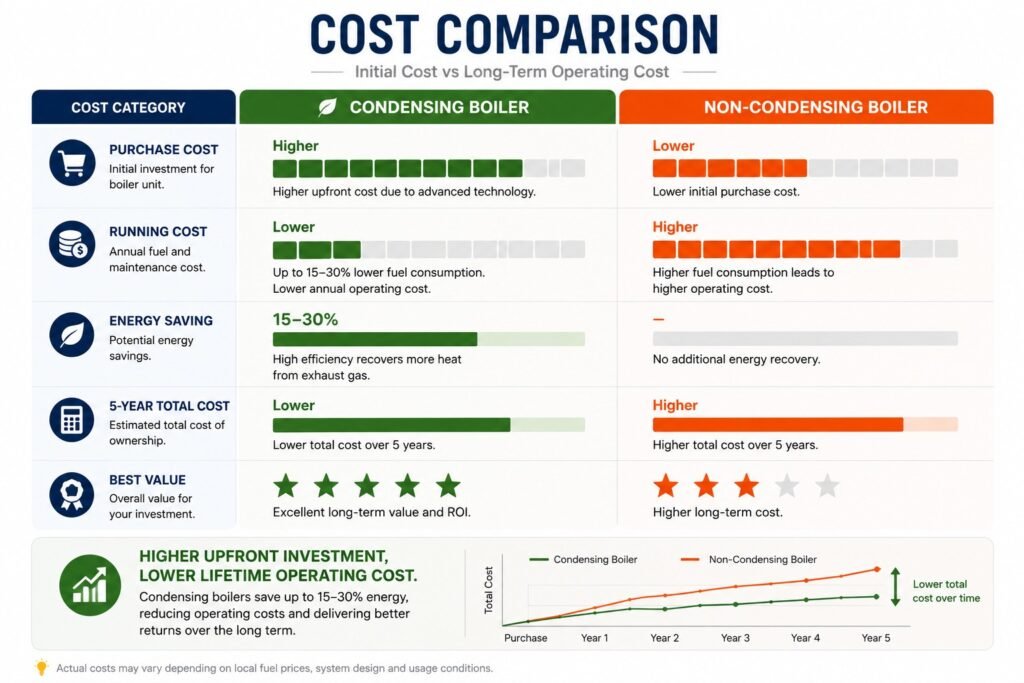
The right choice between a condensing and non-condensing boiler comes down to budget, local regulations, heating demand, and long-term operating goals.
If energy efficiency, environmental performance, and lower fuel consumption are the priority, a condensing boiler is generally the stronger long-term investment. If a project needs a lower initial cost or serves a market where conventional systems remain standard, a non-condensing boiler is still a practical, reliable choice.
For distributors, wholesalers, and OEM partners, offering both technologies provides the flexibility to meet the diverse needs of global markets — explore ROC’s full boiler range or contact us to discuss OEM and ODM options.