

Choosing between a gas boiler vs heat pump is one of the most common decisions homeowners, installers, distributors, and project developers face when planning a new or replacement heating system. Both technologies have matured significantly, and the “better” option depends less on brand and more on the specific project.
A gas boiler can deliver high-temperature heating, fast domestic hot water, compact installation, and reliable performance across many cold-climate applications. A heat pump can reach high seasonal efficiency and, depending on the system, provide both heating and cooling from a single unit.
The right choice depends on climate, energy prices, building insulation, the existing heat-distribution system, domestic hot water needs, installation conditions, and project budget. This guide breaks down the gas boiler vs heat pump comparison in detail to help you choose the right heating solution in 2026.
What Is a Gas Boiler?
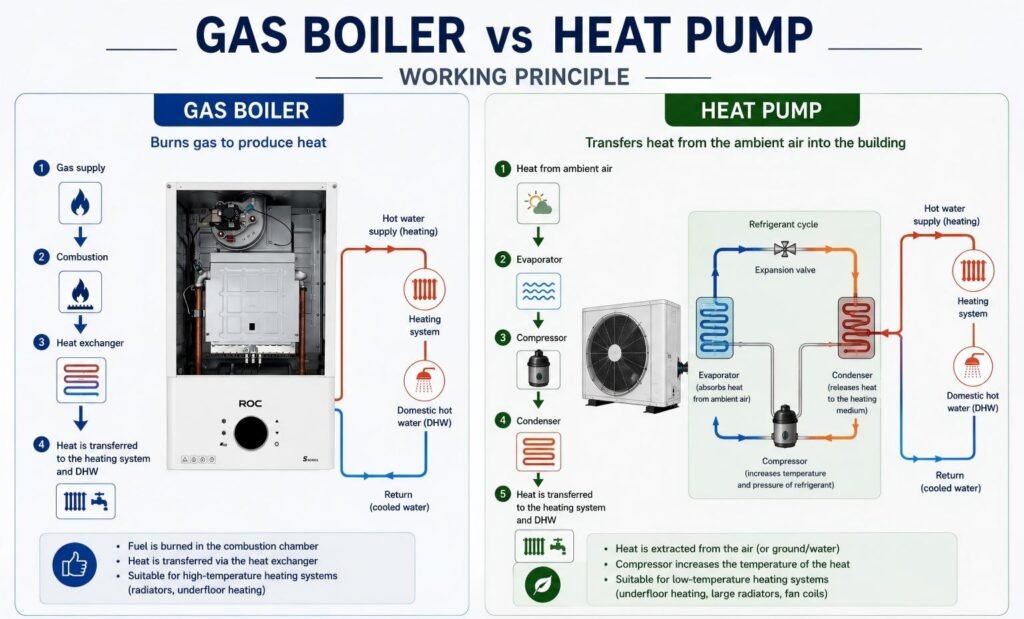
A gas boiler uses the combustion of natural gas or LPG to generate heat. The heat produced is transferred through a heat exchanger to water, which then circulates through radiators, underfloor heating, or other heat emitters.
Modern gas boilers are available in several configurations, including:
- Condensing gas boilers
- Non-condensing gas boilers
- Combi boilers
- System boilers
- Heat-only boilers
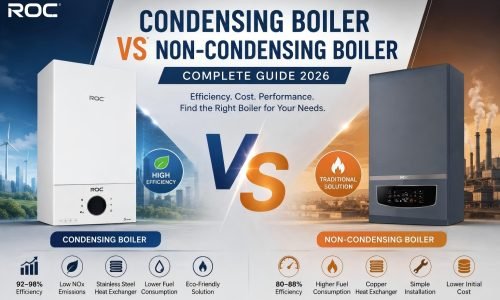
ROC provides a range of wall-hung gas boilers for residential and commercial heating applications, including both traditional and condensing models. For projects where gas infrastructure is already available, a wall-hung boiler is a compact and flexible heating solution.
What Is a Heat Pump?
A heat pump does not generate heat through combustion. Instead, it uses electricity to move thermal energy from an external source — typically outdoor air or the ground — into a building.
For residential and commercial heating, air-source heat pumps are the most common type. A simplified process looks like this:
Outdoor Air → Refrigerant Cycle → Heat Exchanger → Heating Water → Building
The U.S. Department of Energy explains that heat pumps transfer heat rather than generate it directly, which allows them to provide heating and cooling efficiently.
Heat pump performance is commonly evaluated using indicators such as COP (Coefficient of Performance) and seasonal efficiency. For example, a heat pump operating at a COP of 3 can deliver approximately three units of heat for each unit of electricity consumed under the specified test or operating conditions. Actual performance varies with outdoor temperature, heating-water temperature, equipment design, and system conditions.
Gas Boiler vs Heat Pump: Key Differences
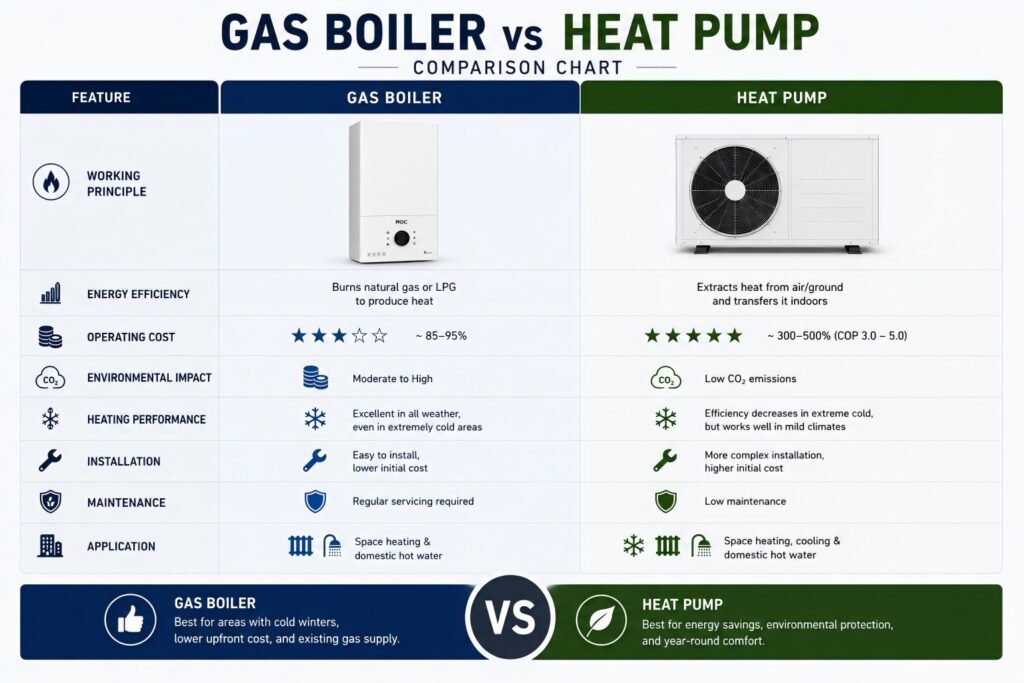
| Feature | Gas Boiler | Heat Pump |
|---|---|---|
| Energy Source | Natural Gas / LPG | Electricity |
| Heating Method | Combustion | Heat transfer |
| Local Combustion | Yes | No |
| Efficiency Metric | Thermal efficiency | COP / seasonal efficiency |
| High-Temperature Heating | Excellent | Model/system dependent |
| Domestic Hot Water | Excellent | Requires suitable system design |
| Installation Space | Compact | Usually requires more system space |
| Gas Connection | Required | Not required |
| Flue | Required | Normally not required |
| Outdoor Unit | No | Required for air-source systems |
| Cooling Capability | Normally no | Possible with reversible systems |
| Cold-Climate Performance | Generally strong | Model and system dependent |
| Upfront Cost | Often lower | Often higher |
| Best Fit | Many retrofit and high-temperature projects | Suitable low-temperature and well-designed projects |
For a complete overview of ROC’s available boiler configurations, see the ROC wall-hung gas boiler product range.
Gas Boiler Efficiency vs Heat Pump Efficiency
Efficiency is one of the biggest differences in the gas boiler vs heat pump debate.
A gas boiler converts the chemical energy in fuel into useful heat. A heat pump uses electricity to transfer heat from one location to another. Because of this, the two technologies shouldn’t be compared using the exact same efficiency metric.
Gas boiler efficiency is generally measured as thermal efficiency, while heat pump efficiency is measured using COP or seasonal performance. A heat pump can have a COP above 1 because it transfers environmental heat instead of generating all of the delivered heat from electricity — but a higher COP doesn’t automatically mean lower heating costs.
The final operating cost depends on:
- Electricity price
- Gas price
- Seasonal efficiency
- Outdoor temperature
- Heating-water temperature
- Building insulation
- Operating schedule
For this reason, project-level analysis is more useful than comparing a single efficiency number.
Running Cost: Which One Is Cheaper?
There is no universal answer. For a fair comparison, look at the cost of delivering the same amount of useful heat.
Gas boiler: Useful heat cost ≈ Gas price ÷ Boiler efficiency
Heat pump: Useful heat cost ≈ Electricity price ÷ COP
If electricity is relatively expensive compared with natural gas, a heat pump may not always have the lowest operating cost despite its high efficiency. On the other hand, where electricity prices are favorable and a heat pump operates efficiently at low water temperatures, its operating cost can be highly competitive.
Local energy prices and real operating conditions should always be checked before selecting a heating system.
Installation Requirements
Gas Boiler Installation
A typical gas boiler installation may require:
- Gas connection
- Flue system
- Heating-water circuit
- Circulation system
- Condensate drainage for condensing models
- Appropriate ventilation and safety systems
- Professional commissioning
One advantage of a gas boiler is that an existing radiator system can often be reused with relatively little modification, depending on the project. For example, ROC’s B Series non-condensing wall-hung gas boiler is built around a compact wall-hung configuration and provides both heating and domestic hot water.
Heat Pump Installation
A heat pump installation may require:
- Outdoor unit
- Indoor hydraulic components
- Electrical connection
- Buffer tank or other hydraulic components where required
- Domestic hot water cylinder where required
- Condensate management
- Appropriate heat emitters
The existing heating system should be evaluated carefully. A building designed around high-temperature radiators may need system modifications if a low-temperature heat pump is used.
Gas Boiler vs Heat Pump in Cold Climates
Cold-climate performance is particularly important for projects in northern Europe, Central Asia, and other regions with severe winters.
Gas boilers generate high-temperature heating water directly through combustion, which makes them well suited to many high-temperature heating systems and a dependable choice for gas boiler for cold climate projects.
Heat pumps can also operate in cold climates, but performance depends strongly on:
- Outdoor temperature
- Heat pump model
- Refrigerant system
- Heating-water temperature
- Building insulation
- Defrost operation
- System design
The U.S. Department of Energy notes that advances in air-source heat pump technology have expanded their use into colder regions, while also highlighting the importance of building weatherization and system conditions. For certified heat pump for cold climate performance, ENERGY STAR uses specific low-ambient criteria, including performance at 5°F (-15°C).
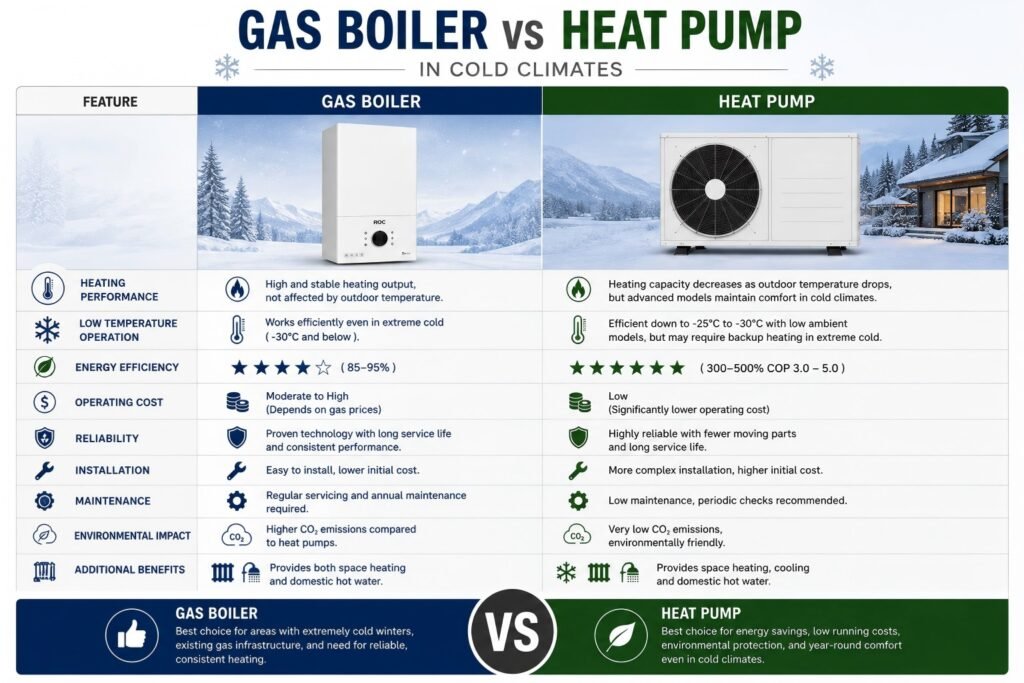
A cold-climate project should never select a heat pump based only on its nominal COP at a mild outdoor temperature — actual cold-climate performance data and design conditions must be reviewed before installation.
Existing Radiators: Can You Replace a Gas Boiler With a Heat Pump?
This is one of the most important questions in retrofit projects, and the honest answer is: it depends.
Traditional radiator systems are often designed around relatively high water temperatures, while heat pumps generally perform best at lower supply-water temperatures. Before replacing a gas boiler with a heat pump, installers should evaluate:
- Building heat loss
- Radiator capacity
- Building insulation
- Window performance
- Required supply-water temperature
- Outdoor design temperature
In some projects, larger radiators, underfloor heating, or other system improvements may be required. The U.S. Department of Energy specifically recommends weatherizing existing homes when replacing gas heating with a heat pump to improve comfort and potential savings.
Domestic Hot Water: Gas Boiler vs Heat Pump
Gas boilers can provide rapid hot-water production, particularly with combi boiler configurations. ROC’s A Series wall-hung gas boiler, for example, supports both heating and domestic hot water and includes features such as ECO mode and Wi-Fi remote control.
Heat pump systems generally require more careful domestic hot water design and often use a storage cylinder. This can affect:
- Installation space
- Recovery time
- System complexity
- Initial investment
- User requirements
For projects with high domestic hot water demand — larger homes, hotels, or commercial buildings — DHW should be sized and evaluated separately from space heating.
Can a Heat Pump Provide Cooling?
Some heat pump systems can provide both heating and cooling when designed as reversible systems, which is a real advantage in buildings that need year-round climate control. Cooling capability depends on the specific heat pump and heat-distribution system — for example, underfloor heating cannot simply double as cooling without addressing condensation control, while fan coils are suitable for many cooling applications.
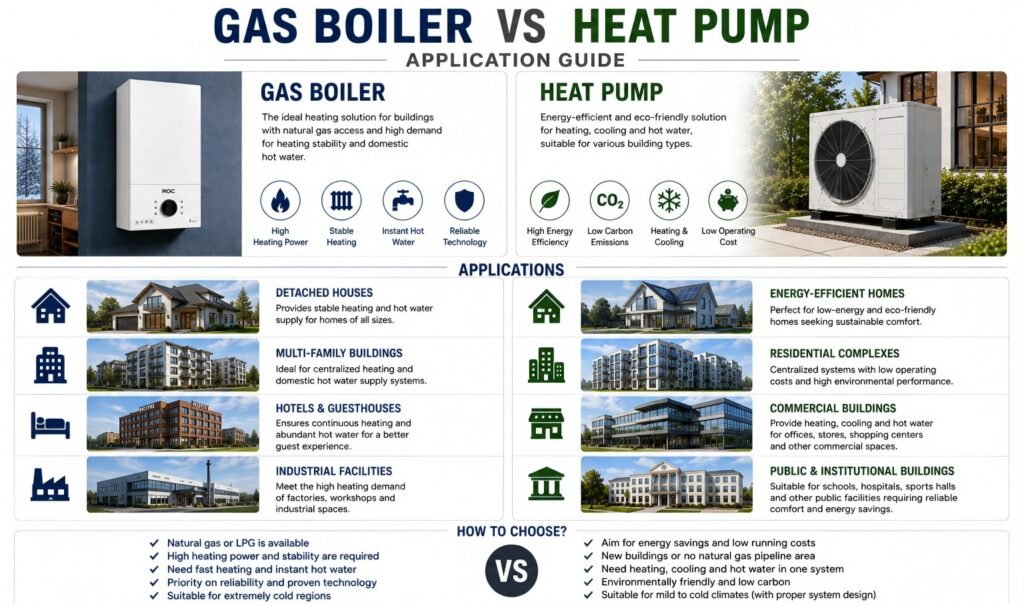
Gas Boiler or Heat Pump: Which Is Better for Different Projects?
Apartment
A gas boiler is practical where gas infrastructure already exists and compact installation matters. A heat pump can be attractive for a new-build or well-insulated apartment designed around low-temperature heating. ROC also offers compact products such as the CG Series wall-hung gas boiler for small-space applications.
Villa
Both technologies can work well here. The decision should weigh insulation, heating demand, existing radiators, domestic hot water demand, available installation space, and local energy prices. For higher-output residential projects, ROC’s CN Series high-power wall-hung boiler is designed for applications such as larger villas.
Hotel
Hotels typically have high heating and domestic hot water demand, so detailed system design is essential. Gas boilers can provide high heating output and rapid DHW production, while heat pumps can be integrated into larger energy systems where conditions allow. A hybrid heating system can also be considered.
Commercial Buildings
Commercial projects require a more detailed evaluation of peak heating load, operating hours, energy tariffs, hot water demand, available electrical capacity, and existing heating infrastructure. There is no single technology suitable for every commercial building.
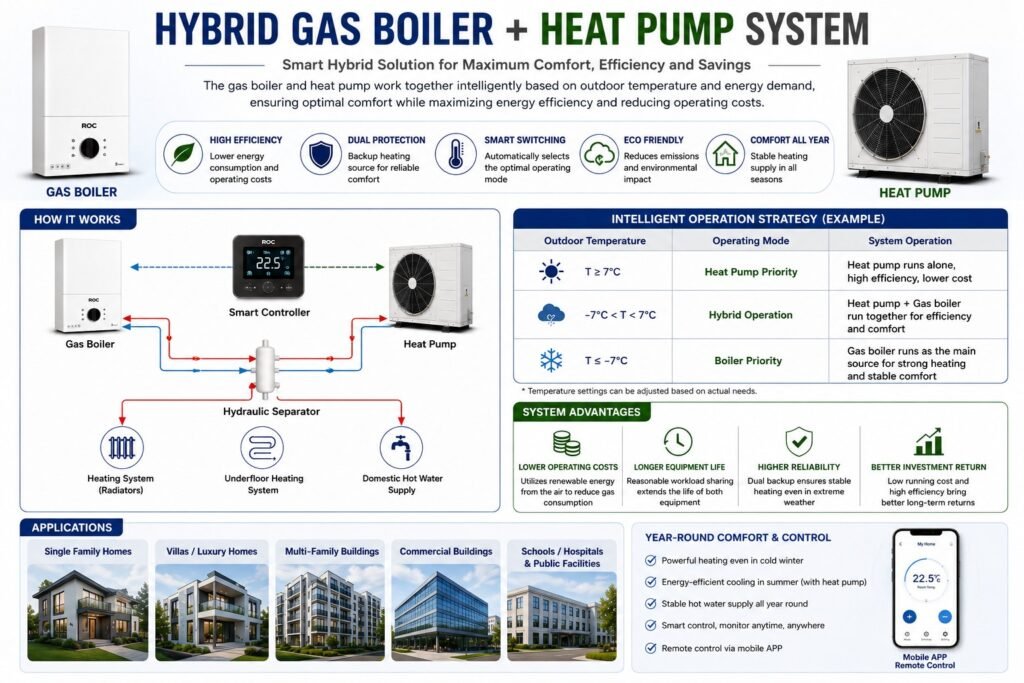
Hybrid Heating System: Gas Boiler + Heat Pump
Choosing between a gas boiler and a heat pump doesn’t always have to be either-or. A hybrid heating system can combine both technologies:
- Heat Pump → Base heating load
- Gas Boiler → Peak load / backup / high-temperature demand
The U.S. Department of Energy describes dual-fuel or hybrid systems as a way to combine heat-pump efficiency with gas heating for colder conditions. This approach is especially useful for retrofit projects where fully replacing an existing heating system would be difficult.
How to Choose Between a Gas Boiler and Heat Pump
Before selecting a heating system, evaluate these eight factors:
- Climate — Is the project located in a mild, moderate, or cold climate?
- Building Insulation — Well-insulated buildings generally need less heating energy and may suit low-temperature heating.
- Existing Heating System — Check radiator capacity and required water temperature.
- Energy Prices — Compare local electricity and gas prices rather than relying on efficiency figures alone.
- Domestic Hot Water — Determine whether the project needs instantaneous or stored hot water.
- Installation Space — Consider both indoor and outdoor equipment.
- Initial Investment — Compare equipment, installation, system modifications, and commissioning costs.
- Long-Term Operating Strategy — Consider expected energy prices, maintenance, system lifetime, and future regulations.
For European projects, heat-pump deployment is increasingly tied to broader building decarbonization policy. The European Commission’s Heat Pump Accelerator Platform describes heat pumps as an important part of the EU’s clean-energy transition.
Quick Decision Guide
| Project Requirement | Generally More Suitable |
|---|---|
| Existing gas infrastructure | Gas Boiler |
| Limited installation space | Gas Boiler |
| High-temperature radiator system | Gas Boiler |
| Rapid DHW production | Gas Boiler |
| New well-insulated building | Heat Pump |
| Low-temperature heating system | Heat Pump |
| Heating + Cooling | Heat Pump |
| No gas connection | Heat Pump |
| Difficult retrofit | Depends on project |
| Peak-load backup required | Hybrid System |
This table is a starting point rather than a universal rule. Final equipment selection should be based on a proper heat-load calculation and system design.
ROC Gas Boiler Solutions for Global Heating Projects
ROC provides wall-hung gas boiler solutions for residential and commercial applications worldwide. Our product portfolio includes:
- Traditional wall-hung gas boilers
- Condensing gas boilers
- Combi boilers
- System boilers
- Heat-only boilers
- OEM and private-label solutions
For distributors and project contractors, the appropriate gas boiler can be selected according to heating capacity, domestic hot water demand, fuel type, climate, control requirements, and local market regulations.
Explore the complete ROC wall-hung gas boiler product range to compare available models and configurations. For projects requiring higher efficiency and lower emissions, ROC’s CE Series condensing wall-hung gas boiler uses full premixed condensing technology and is designed for intelligent heating applications.
Frequently Asked Questions
Is a heat pump more efficient than a gas boiler?
A heat pump can achieve very high efficiency because it transfers heat rather than generating all delivered heat through combustion. Actual seasonal performance depends on climate, water temperature, building conditions, and system design.
Is a gas boiler better than a heat pump in cold weather?
Gas boilers can be advantageous for applications requiring high-temperature heating and rapid heat output. Modern heat pumps can also operate in cold climates, but their performance and capacity should be evaluated at the project’s actual design temperatures.
Can a heat pump replace a gas boiler?
It can in many projects, but the existing heating system, building insulation, heat load, water temperature, electrical capacity, and domestic hot water requirements should be evaluated first.
Which costs less to operate: a gas boiler or heat pump?
It depends on local gas and electricity prices and the seasonal performance of the equipment. A simple comparison of rated efficiency isn’t sufficient.
Can a gas boiler and heat pump work together?
Yes. Hybrid systems can use a heat pump for part of the heating load and a gas boiler for peak demand, backup heating, or high-temperature requirements.
Final Thoughts
There is no single heating technology that’s best for every building. In the gas boiler vs heat pump comparison, gas boilers remain a practical solution for projects requiring compact equipment, high-temperature heating, rapid hot water production, or compatibility with existing gas and radiator infrastructure.
Heat pumps can be highly efficient for well-designed, well-insulated buildings with suitable low-temperature heating systems and favorable electricity conditions. For some projects, the best solution may be a hybrid system combining a heat pump and gas boiler.
The right decision should ultimately be based on the building, climate, energy prices, heating system, domestic hot water requirements, and long-term project objectives.