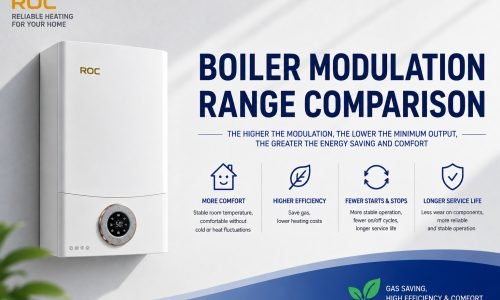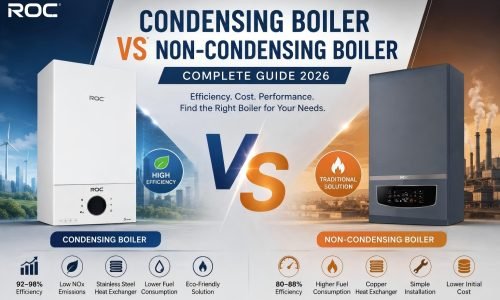


When selecting a gas boiler, buyers often compare heating output, efficiency, heat exchanger design and control functions. However, one specification is frequently overlooked: boiler modulation ratio.
A boiler’s modulation ratio determines how far the burner can reduce its firing rate from maximum output to minimum output. In practical terms, it affects how closely the boiler can match the actual heating demand of a building.
For heating systems, this matters because a boiler does not operate at maximum power all the time. During much of the heating season, the actual heat demand may be far below the design load.
A boiler with a wider and well-controlled modulation range can reduce its output instead of repeatedly switching completely on and off. This can improve temperature stability, reduce unnecessary cycling and help the system operate more efficiently under part-load conditions.
What Is Boiler Modulation Ratio?
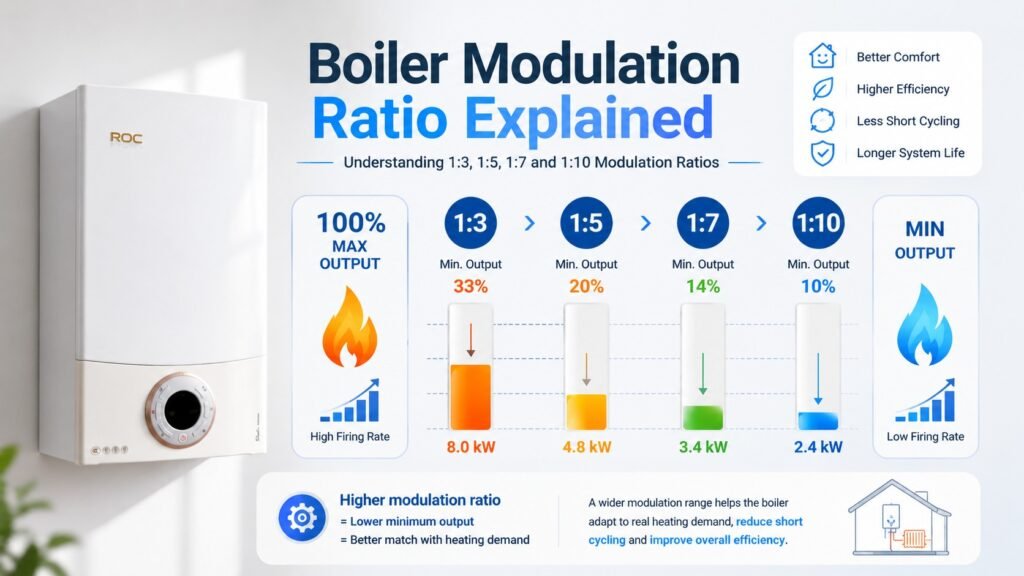
The boiler modulation ratio, also called the turndown ratio, describes the relationship between a boiler’s maximum firing rate and its minimum stable firing rate.
The basic calculation is:
Modulation Ratio = Maximum Heat Input ÷ Minimum Heat Input
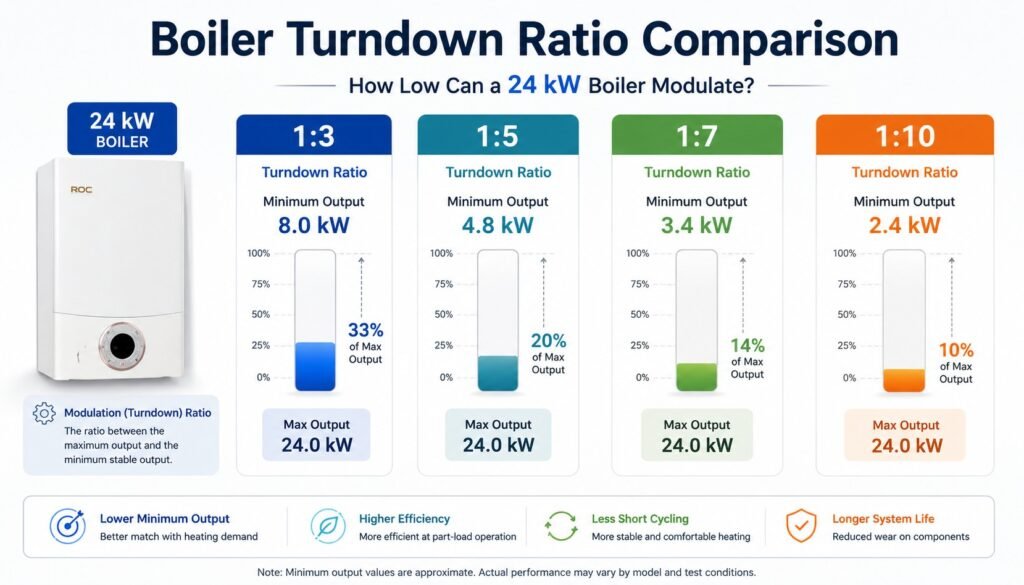
For example, a boiler with a 24 kW maximum heat input and a 4.8 kW minimum heat input has a:
24 ÷ 4.8 = 5
Therefore, its modulation ratio is approximately 1:5.
| Maximum Output | Modulation Ratio | Approximate Minimum Output |
|---|---|---|
| 24 kW | 1:3 | 8.0 kW |
| 24 kW | 1:5 | 4.8 kW |
| 24 kW | 1:7 | 3.4 kW |
| 24 kW | 1:10 | 2.4 kW |
The important point is that a higher modulation ratio allows the burner to operate at a lower percentage of its maximum firing rate, provided stable combustion can be maintained across the operating range.
Why Is Minimum Boiler Output Important?
Many people focus on the maximum output of a boiler because heating capacity is commonly used for initial product selection. However, minimum output becomes increasingly important once the heating system is operating under part-load conditions.
Consider a 24 kW boiler installed in a building that currently needs only 5 kW of heating capacity.
If the boiler can modulate down to 4.8 kW, its available minimum output is very close to the actual heating demand.
If the same boiler could only reduce its output to 8 kW, the boiler would still be producing substantially more heat than the building currently requires.
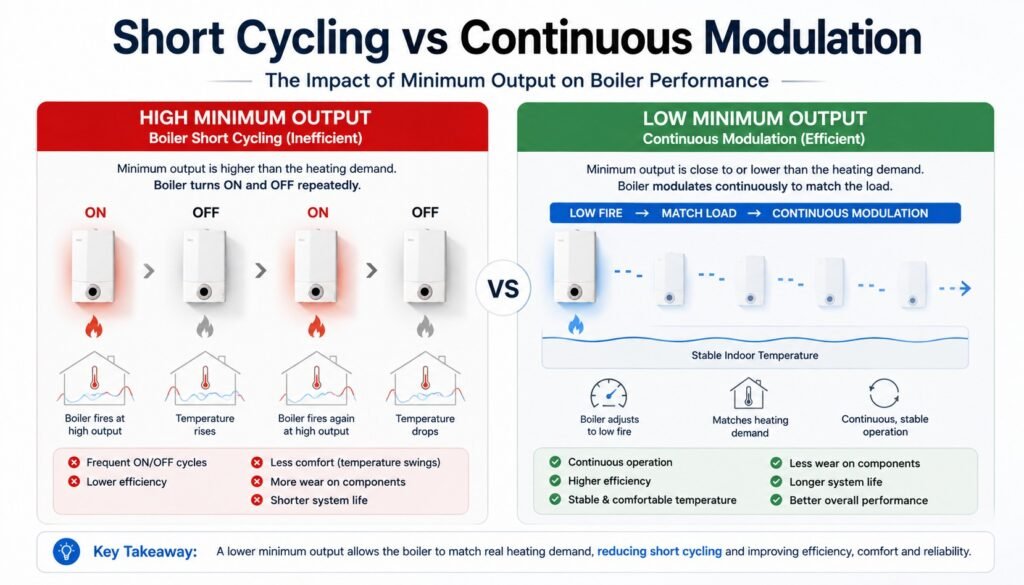
The control system may then need to stop the burner after the target temperature is reached and restart it when more heat is required.
This repeated start-stop behavior is commonly referred to as short cycling.
What Is Boiler Short Cycling?
Boiler short cycling occurs when a boiler reaches its operating target quickly, shuts down and then restarts again because its minimum available output is higher than the current heating demand.
The U.S. Department of Energy describes short cycling as a condition in which an oversized boiler quickly satisfies the heating demand and then shuts down until heat is required again. DOE also notes that cycling can reduce efficiency because losses associated with each operating cycle become more significant at low loads.
Read the U.S. Department of Energy guidance on boiler short cycling .
For heating applications, short cycling can affect:
- Temperature stability
- Part-load operating efficiency
- Burner and ignition component operating cycles
- User comfort
- Overall heating system control
This is why minimum firing capability should be considered together with maximum heating output when selecting a boiler.
1:5 vs 1:7 vs 1:10 Boiler Modulation Ratio
The difference becomes easier to understand when the same maximum boiler output is used for comparison.
| Modulation Ratio | Maximum Output | Approx. Minimum Output | Typical Advantage |
|---|---|---|---|
| 1:3 | 24 kW | 8.0 kW | Limited low-load operation |
| 1:5 | 24 kW | 4.8 kW | Good balance for many residential applications |
| 1:7 | 24 kW | 3.4 kW | Better low-load matching |
| 1:10 | 24 kW | 2.4 kW | Very wide modulation range |
However, a higher number should not automatically be interpreted as a better boiler.
A wide theoretical modulation range is useful only when the burner, gas valve, fan, control board and combustion system can maintain stable and appropriate combustion at low firing rates.
In other words:
A wider modulation range is valuable only when the boiler can use that range effectively.
Does a 1:10 Modulation Ratio Always Mean Better Performance?
No.
A 1:10 modulation ratio provides a lower theoretical minimum firing point than 1:5 for the same maximum input. That can be particularly useful when the building’s heating load is frequently low.
But the actual performance of a boiler depends on more than the ratio itself.
Important factors include:
- Minimum stable combustion level
- Gas valve control accuracy
- Combustion fan control
- Burner design
- Control board logic
- Heating system water volume
- System flow rate
- Return water temperature
- Actual building heat load
This is particularly important for condensing boilers because they are designed to operate efficiently under part-load conditions. In its acquisition guidance for gas-fired hot-water boilers, DOE’s Federal Energy Management Program lists modulating burners alongside condensing operation, temperature reset and low-mass design as features that help a boiler run more efficiently and avoid excessive cycling.
See the U.S. Department of Energy guidance on purchasing energy-efficient boilers .
How Modulation Ratio Affects Condensing Boiler Performance
Condensing boilers are especially suited to modulation because heating demand changes continuously during normal operation.
For example, a building may require close to its design heating capacity during a very cold period. At other times, the actual load may be much lower because outdoor conditions are milder or the building has already reached its target temperature.
Instead of running continuously at full fire and then shutting down, a modulating boiler can reduce burner input as the heating demand decreases.
This can help maintain a more stable relationship between heat generation and heat demand.
Lower return-water temperatures are also important for condensing operation because they allow more favorable conditions for recovering heat from water vapor in the flue gas.
For this reason, modulation should not be evaluated independently. Boiler efficiency, control strategy, hydraulic design and return-water temperature all influence actual system performance.
ROC Boiler Example: Looking at Real Product Data
The easiest way to understand modulation is to look at actual boiler specifications.
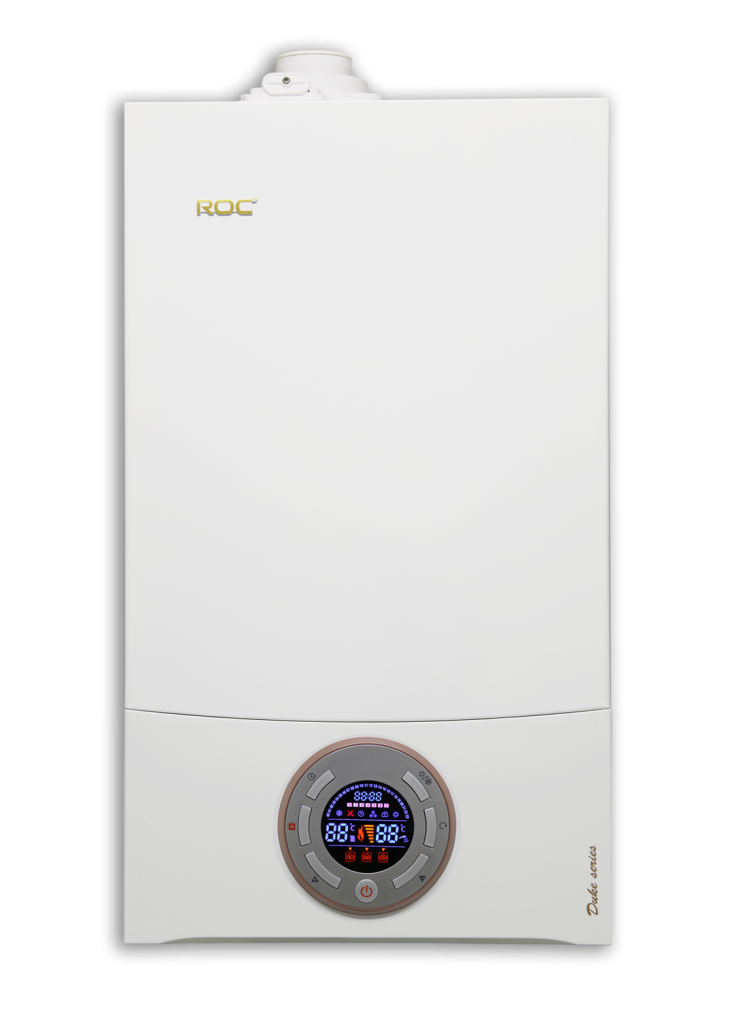
ROC’s CG Series condensing wall-hung gas boilers provide several useful examples.
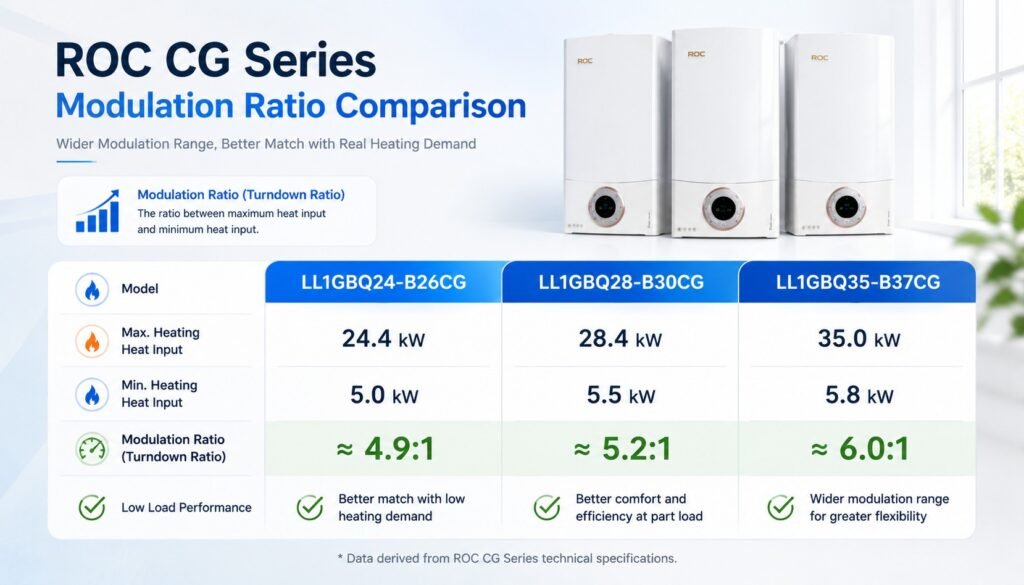
| ROC CG Model | Maximum Heating Heat Input | Minimum Heating Heat Input | Approx. Ratio |
|---|---|---|---|
| LL1GBQ24-B26CG | 24.4 kW | 5.0 kW | 4.9:1 |
| LL1GBQ28-B30CG | 28.4 kW | 5.5 kW | 5.2:1 |
| LL1GBQ35-B37CG | 35.0 kW | 5.8 kW | 6.0:1 |
These values are calculated from the maximum and minimum heating heat-load figures published in the ROC CG Series specifications.
The result illustrates an important point: the actual modulation capability of a boiler should be evaluated from its technical data rather than from a marketing number alone.
View the ROC CG Series Condensing Gas Boiler .
How Traditional and Condensing Boilers Can Differ
Modulation performance also differs between boiler technologies and product designs.
For example, ROC’s A Series non-condensing wall-hung gas boilers list maximum and minimum heating heat-load values that vary by model. The L1PB20-A8 model is listed at 20 kW maximum heating heat load and 7 kW minimum heating heat load, which corresponds to approximately 2.9:1 when calculated from those figures.
This does not mean that every non-condensing boiler has the same modulation capability. It simply demonstrates why buyers should compare the actual maximum and minimum firing or heat-input data for each model.
View the ROC A Series Non-Condensing Gas Boiler .
Why Boiler Sizing Still Matters
A good modulation ratio cannot completely solve an incorrectly sized heating system.
If a boiler is significantly oversized compared with the building’s actual heat load, even a relatively wide modulation range may not prevent cycling under certain operating conditions.
For example:
| Building Load | Boiler Maximum Output | Minimum Output | Result |
|---|---|---|---|
| 5 kW | 24 kW | 4.8 kW | Good low-load matching |
| 3 kW | 24 kW | 4.8 kW | Minimum output is still above demand |
| 12 kW | 24 kW | 4.8 kW | Wide operating range available |
This is why professional boiler selection should consider both:
- Required maximum heating capacity
- Minimum operating capacity during low-load conditions
What Should Buyers Ask a Boiler Manufacturer?
When evaluating a gas boiler for distribution, OEM or project applications, asking only for the nominal kW rating is not enough.
A better technical specification sheet should include:
- Maximum heat input
- Minimum heat input
- Maximum heating output
- Minimum heating output
- Modulation or turndown ratio
- Gas valve type
- Burner control method
- Fan control method
- Minimum stable combustion level
- Control logic at low load
- Heating temperature range
- Return-water temperature requirements
- Condensing efficiency at part load
For distributors and OEM buyers, these parameters provide a much more useful technical picture than the maximum kW rating alone.
Boiler Modulation Ratio and Short Cycling: The Practical Connection
The relationship can be summarized simply:
| Higher Minimum Output | Lower Minimum Output |
|---|---|
| More likely to exceed low heating demand | Better ability to match low heating demand |
| Greater risk of cycling under low-load conditions | Potentially longer burner operating periods |
| Less flexibility at part load | More flexibility at part load |
The objective is not simply to find the largest modulation ratio. The objective is to achieve a good match between the boiler’s operating range and the building’s real heating demand.
How to Choose the Right Modulation Ratio
For residential heating applications, a boiler with approximately 5:1 or greater modulation capability can provide a useful balance between maximum capacity and low-load operation, provided the combustion system is properly engineered.
For larger systems or applications with highly variable loads, a wider modulation range may provide additional flexibility.
However, engineers and distributors should always evaluate the complete technical specification rather than selecting a boiler solely from its modulation ratio.
Modulation Ratio vs Boiler Efficiency
These two specifications are related, but they are not the same.
A boiler may have a wide modulation range while achieving poor performance because of control, combustion or system limitations.
Likewise, a boiler with a moderate modulation ratio can still provide strong overall efficiency when properly sized and integrated into a heating system.
For condensing boilers, part-load performance is particularly important. ROC’s CG, CE and CN condensing boiler families use fully premixed condensing technology and publish part-load and minimum-output specifications for their models.
Explore the ROC CE Series Condensing Gas Boiler
Explore the ROC CN Series Condensing Gas Boiler
Final Takeaway
The boiler modulation ratio is one of the most useful specifications for understanding how a gas boiler performs under changing heating loads.
A 1:5 boiler can reduce its firing rate much further than a 1:3 boiler. A 1:10 boiler can theoretically operate at an even lower percentage of maximum input. However, the ratio alone does not determine real-world performance.
A professional boiler evaluation should consider:
- Maximum heating capacity
- Minimum heating capacity
- Modulation ratio
- Combustion stability
- Control strategy
- Boiler sizing
- Heating system design
- Return-water temperature
For distributors and heating-system professionals, the right question is therefore not simply: “Does this boiler have a high modulation ratio?”
The better question is: “Can this boiler maintain stable, efficient operation across the actual load range of my heating system?”
That is where detailed technical specifications become more valuable than headline numbers.
Frequently Asked Questions
What is a boiler modulation ratio?
A boiler modulation ratio describes how far the burner can reduce its firing rate from maximum to minimum stable operation. It is commonly expressed as 1:5, 1:7 or 1:10.
Is a higher boiler modulation ratio better?
Not automatically. A higher ratio can improve low-load operating flexibility, but stable combustion, control accuracy, system sizing and hydraulic design are also important.
What does a 1:5 boiler modulation ratio mean?
A 1:5 ratio means that the boiler can theoretically reduce its firing rate to approximately one-fifth of its maximum firing rate. For a 25 kW maximum heat input, that corresponds to approximately 5 kW minimum heat input.
What is boiler short cycling?
Boiler short cycling occurs when a boiler reaches its control target quickly, shuts down and then restarts repeatedly because its minimum available output is higher than the current heating demand.
Why is modulation important in condensing boilers?
Condensing boilers commonly operate at part load, so the ability to reduce firing output can help the boiler better match changing heating demand and reduce unnecessary cycling.
How should I compare boiler modulation ratios?
Compare the actual maximum and minimum heat-input or firing-rate data, not only the advertised ratio. Also consider combustion stability, controls, efficiency at part load, heating load and system design.
Related ROC Resources
- ROC CG Series Condensing Gas Boiler
- ROC CE Series Condensing Gas Boiler
- ROC CN Series Condensing Gas Boiler
- ROC A Series Non-Condensing Gas Boiler
- ROC Wall-Hung Gas Boiler Product Range
Looking for the Right Boiler for Your Market?
ROC develops wall-hung gas boilers and condensing gas boiler solutions for residential heating, domestic hot water, OEM and ODM applications.
Contact ROC to discuss boiler output, modulation range, controls, fuel type and configuration requirements for your market.